Mindful Eating, the New Weight Loss Program

Mindful eating is maintaining an in-the-moment awareness of the food and drink you put into your body. It involves observing how the food makes you feel and the signals your body sends about taste, satisfaction, and fullness. Mindful eating requires you to simply acknowledge and accept rather than judge the feelings, thoughts, and bodily sensations you observe. It can extend to the process of buying, preparing, and serving your food as well as consuming it.

Countless weight loss programs are launched every year and everyone is claiming to be easier, faster, and more effective than the other. From low carbs planning to the paleo diet, and most recently, the ketogenic diet, they all claimed to have a solution for losing a few pounds. By no means am I claiming that they do not work, in fact, I am delighted to draw one learning point from all these dieting programs – mindful eating. If we take a closer look at the concept behind the myriad of dieting plans out there, the key to reaping success from any one of them is really about conscious eating. It is about what we eat, how we eat, and why we eat. Putting aside the different ingredients and recipes, the reminder here is about paying attention, and that is what mindful living is all about.

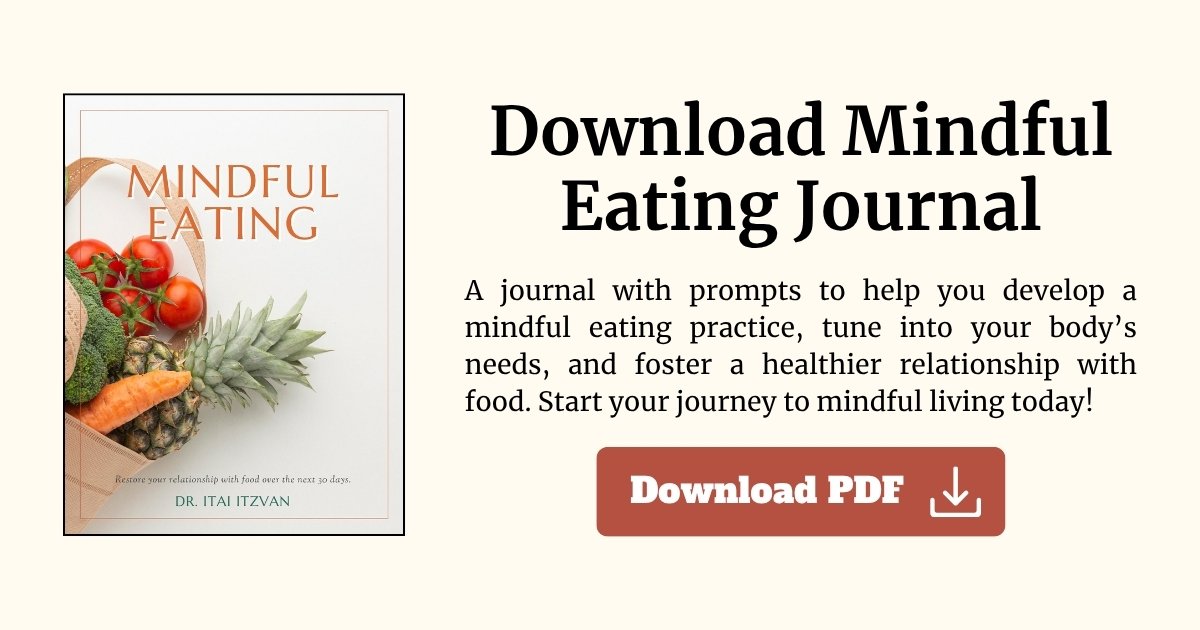
Before you continue you might like to consider our free worksheet on exploring “Mindful Eating”. Please download this worksheet here.

Unconscious Eating that Leads to Weight Gain

In a world where we are tempted with an ever-growing list of “must-try” foods and beverages in the marketplace, it is not surprising that we are in the habit of buying and consuming because we are making unconscious buying decisions. Some of us probably stocked up truckloads of potato chips at home thinking that they are such delicious treats. But when it comes to appreciating them, do we really put much focus on how they taste and how our body is reacting to them? Or are we too busy focusing our attention on the television while shoving the chips down our throats? A study mentioned in the Sage Journal indicated that people make more than 200 decisions about food every day, but we can only recall a very small fraction of them. So, if we are not even conscious of what leads us to our choice of food and why we eat, the chances of overeating and weight gaining naturally increases.

It was noted in a study listed in the National Center for Biotechnology Information (NCBI) that our eating behavior is often triggered by external factors rather than internal cues from our bodies. In the study with 54 participants, some of them were invited to eat from self-refilling soup bowls while others were served normal soup bowls. At the end of the experiment, those who consumed from the self-refilling bowls were reported to have consumed 73% more than those who ate from the regular bowls, but the former group of participants was unaware that they had eaten more, even though they consumed 100 calories more than the others!
Benefits of Mindful Eating

While we are focused on the hustle and bustle of everyday life, mindless eating can easily infiltrate our lifestyle. If we are not aware of our patterns, we can easily overeat and gain excessive weight even when we thought we are merely consuming regular healthy meals. Our brain takes up to 20 minutes to realize that we feel full, so if we are fast eaters, the possibility of consuming too much too fast is very likely. Needless to say, that is the first step to weight gain.

Mindful eating is a technique that helps us to gain control of our eating habits and improve weight loss. If we can exercise more mindfulness in our daily eating behavior, we can certainly cut back a lot of calories, binge-eating, and even expenditure. Mindful eating is about being fully aware of our eating behavior, our triggers, our cravings, and how our food makes us feel. If we can be conscious of our food experience; from the point of purchasing our food to the moment that we consume them, we will tend to make wiser and healthier decisions. The truth is, there is no need for any fancy expensive diet plans, all we need is to exercise mindfulness in your eating behavior.


Incorporating Mindfulness Eating in Your Daily Life

There is no need to create an ultra-strict diet plan in the name of mindful eating. Start by cultivating awareness during mealtimes. Slow down the process of eating and learn to appreciate what you are eating. Give attention to the food that you consume, acknowledge how it looks and how it tastes. Take a moment to observe how your body is reacting during eating. When you can observe what your body is trying to tell you, it will always give you subtle cues on how it feels when you eat. Is the food making you feel thirsty? Is that chunk of red meat sitting well with your stomach? Is that soda causing a reaction in your gum? When you begin to take time to observe, it will not be long before you start to gravitate towards healthier choices that will boost your metabolism and inject more fun into your eating routine.


If you’re ready to take control of your eating habits and start your journey toward healthier choices, download our free ‘Mindful Eating Workbook’ and begin cultivating awareness in every bite today.

WAIT!

Before you go, we'd like to give you a FREE workbook to support your journey 👇

Smiling woman with wavy brown hair wearing a navy blazer and white shirt, standing in a softly blurred office setting, conveying positivity.

Carolyn Freyer-Jones

Kickstart Your Coaching Practice

Highlights & Achievements:

Coach, facilitator, and contributor to coaching education. Carolyn is associated with practical coaching training and learning resources, supporting coaches and leaders in developing effective, ethical, and reflective coaching practices.
Man in a light blue shirt smiles gently at the camera. He has short, dark hair and stands against a blurred indoor backdrop, conveying warmth and approachability.

Rob Willson

Cognitive Behavioral Coaching

Highlights & Achievements:

Coach and educator contributing to leadership and coaching skills development. Rob is involved in professional training contexts, supporting the application of coaching tools and methodologies in organisational settings.
A woman with shoulder-length blonde hair is confidently posing with crossed arms. She wears a black and white checkered outfit and a necklace. The background is softly blurred, suggesting an indoor setting.

Prof. Ilona Boniwell

Positive Psychology Coaching

Highlights & Achievements:

Professor of Positive Psychology and Coaching Psychology. Ilona is a pioneer of applied positive psychology education in Europe and has founded and led postgraduate programmes in the field. Her work focuses on wellbeing, resilience, strengths, and evidence-based positive psychology interventions.
A middle-aged man with short gray hair and a beard wears a white turtleneck and a navy blue striped sweater, standing confidently indoors.

Jon Williams

Coaching for Performance

Highlights & Achievements:

Coach and contributor to professional coaching education and training programmes. Jon is involved in leadership and coaching development initiatives, supporting skill-building and reflective practice within organisational and coaching contexts.
A man in a blue suit and light blue shirt, with curly blond hair, smiles softly against a blurred, bright indoor background, conveying professionalism.

Prof. Erik de Haan

Relational Coaching

Highlights & Achievements:

Professor, executive coach, and leading expert in coaching supervision. Erik is widely recognised for his contributions to relational coaching, organisational development, and reflective practice, supporting both individual coaches and leadership systems worldwide.
Elderly man in a dark suit and striped shirt smiles warmly, standing in a bright, blurred background. The tone is professional and approachable.

Prof. Peter Hawkins

The Coaching Relationships

Highlights & Achievements:

Professor of Leadership and a leading authority in systemic team coaching and coaching supervision. Peter works internationally with boards, leadership teams, and organisations, and has written extensively on leadership, coaching culture, and systemic change.
Smiling older man in glasses and a light pink shirt sits indoors, with a softly blurred background of a modern, brightly lit office space.

Prof. David Clutterbuck

Goals

Highlights & Achievements:

One of the world’s most influential figures in coaching and mentoring. Professor Clutterbuck has authored and co-authored foundational texts in coaching, mentoring, and organisational development. His work has shaped global standards for coaching practice, supervision, and mentoring relationships.
A bald man in a dark, buttoned shirt with patterned cuffs stands indoors. He smiles subtly, with a bright, blurred background, exuding a calm, confident presence.

Devon White

Communication

Highlights & Achievements:

Coach and leadership development practitioner involved in contemporary coaching education. Devon has contributed to professional coaching programmes and discussions alongside established academics and practitioners in the coaching field.
Smiling woman with short auburn hair wearing a black dress and polka dot jacket. She stands confidently in a bright, blurred office setting.

Linda Aspey

The Coaching Relationships

Highlights & Achievements:

Coach, facilitator, and contributor to professional coaching education. Linda is recognised within the coaching psychology and leadership development community for her involvement in learning programmes, events, and reflective coaching practice.
A woman with short white hair smiles confidently, wearing a red blazer with a popped collar. The background is softly blurred, creating a warm, professional ambiance.

Dr. Chérie Carter-Scott

Psychological Foundations

Highlights & Achievements:

Executive coach, author, and pioneer in the coaching profession. Often referred to as “The Mother of Coaching,” Dr. Carter-Scott has been a leading voice in personal and professional development since the 1970s. She is a bestselling author and has trained coaches and leaders worldwide in motivation, leadership, change, and self-esteem.
Smiling man in suit with colorful tie stands in bright, blurred office. Hands clasped, he exudes confidence and warmth.

Prof. Jonathan Passmore

An Introduction to Coaching

Highlights & Achievements:

Chartered Psychologist, Professor of Coaching and Behavioural Change, executive coach, and author. Jonathan has published extensively in coaching psychology, leadership, and organisational change, including numerous academic articles and books. He bridges academic research and applied practice, contributing globally to coach education and evidence-based coaching.
Smiling man in a black suit and white shirt stands against a softly blurred, bright background. The atmosphere is professional and approachable.

Dr. D. Ivan Young

The Coaching Relationships

Highlights & Achievements:

Coach, educator, and thought leader in professional and relationship-focused coaching. Dr. Young is frequently featured alongside senior coaching scholars and practitioners in advanced coaching education and professional development settings, contributing to the evolution of reflective and relational coaching practice.
Smiling woman with short red hair wearing a blue blouse and earrings, standing in a softly blurred indoor setting, conveying a warm, professional tone.

Catherine Bell

Psychological Foundations

Highlights & Achievements:

Professional Certified Coach (PCC) and Master of Applied Positive Psychology (MAPP). Catherine specializes in leadership transitions, executive presence, and sustainable performance. Her work combines positive psychology, emotional intelligence, and strategic leadership development to help leaders thrive while maintaining wellbeing and purpose.
Smiling man in a navy blazer and shirt stands confidently with hands in pockets. The backdrop is a softly blurred office environment, conveying professionalism.

Yannick Jacob

An Introduction to Coaching

Highlights & Achievements:

Existential Coach, Positive Psychologist, Coach Trainer, and Supervisor. Yannick is the Programme Lead for the Accredited Certificate in Integrative Coaching at the School of Positive Transformation. He has taught coaching, positive psychology, and personal development at institutions including the University of East London, Animas Centre for Coaching, and The School of Life. His work integrates existential philosophy, coaching psychology, and human development to support meaningful change in individuals and leaders.
mindful eating the new weight loss program

Highlights & Achievements: